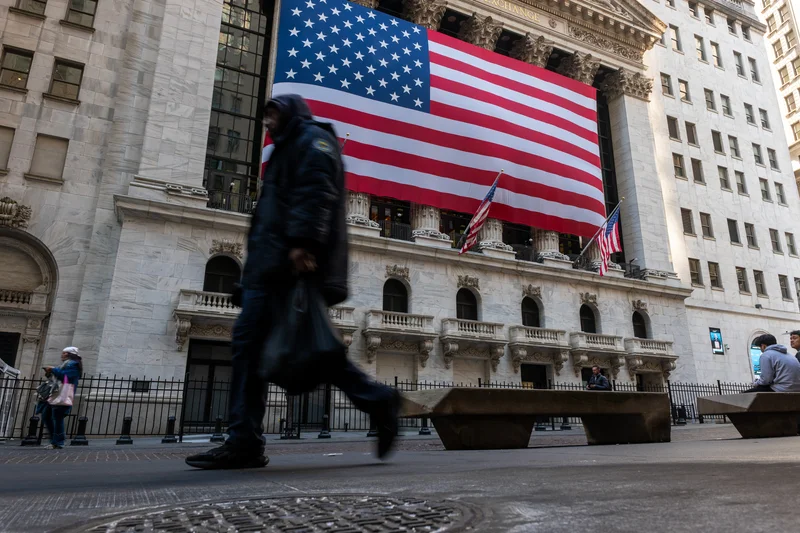
Okay, let’s be real. Seeing the Dow take a nearly 800-point nosedive? Not exactly the kind of Thursday thrill ride we were hoping for. Headlines are screaming "tech sell-off," and yeah, it's true, some of the big names took a hit. Stocks notch worst day in over a month as tech sell-off intensifies But before you start panic-selling your grandma’s retirement fund, take a breath. Let's zoom out and look at the bigger picture.
What we're seeing isn't a crash; it's a correction. Think of it like debugging code. Sometimes, you need a system-wide error to identify the underlying issue and rewrite for optimal performance. And honestly, this market "tantrum" might just be the launchpad we needed for the next phase of tech innovation.
The market's been frothy, fueled by the promise of future tech leaps. But promises are cheap. What the market needed was a gut check, a reminder that even the most hyped sectors need to deliver real, tangible results. That’s what this “sell-off” is forcing.
See, the shutdown threw a wrench in everything. We're talking about the potential loss of critical economic data. As Karoline Leavitt at the White House put it, Democrats may have "permanently damaged the federal statistical system." October CPI and jobs reports might never see the light of day. And that, my friends, creates uncertainty. Uncertainty breeds fear, and fear? Well, fear makes investors jittery.
But here's the thing: the market overreacted. The fear of the unknown shouldn't overshadow the very real progress we're making in AI, biotech, sustainable energy, and countless other fields. This isn’t the dot-com bubble bursting. This is a temporary dip caused by a temporary political hiccup.
Now, some will say, "Dr. Thorne, you're being overly optimistic!" And maybe I am. But I prefer to see opportunity where others see disaster. This isn’t the first time the market has thrown a fit, and it sure as heck won’t be the last. Remember the early days of the internet? It was a wild west of dial-up connections and Geocities websites. People laughed. They scoffed. They said it was a fad. And look at us now.
Think of it this way: this market correction is like pruning a fruit tree. You might lose a few branches, but the overall health and yield of the tree improve dramatically. The strong survive, and the weak get weeded out. This creates space for real innovation to flourish. The companies that are actually building the future, not just hyping it, will rise to the top.
This also forces the Fed's hand, doesn't it? The article notes the probability of a December rate cut dropped significantly. But with this new layer of economic uncertainty, wouldn't a rate cut actually be more likely? The Fed doesn't want to send the economy into a tailspin. This could be the perfect storm to trigger the very stimulus the market was hoping for. I mean, wouldn't you want a little insurance policy if you were steering the economic ship?
And beyond the immediate market reaction, this data blackout forces us to re-evaluate how we collect and analyze economic information. Are our current methods robust enough to withstand these kinds of disruptions? Can we leverage AI and machine learning to fill in the gaps when traditional data sources fail? This is an opportunity to build a more resilient and intelligent economic infrastructure.
I saw a fascinating comment on a Reddit thread discussing this very issue. One user wrote, "This is painful now, but it's forcing a much-needed conversation about transparency and data integrity." Exactly! It's a painful lesson, but a valuable one.
What does this mean for us? It means opportunity. Opportunity to invest in undervalued companies with solid fundamentals. Opportunity to double down on the technologies that are truly changing the world. Opportunity to build a more resilient and equitable future. But more importantly, what could it mean for you? Imagine a world where technology solves our biggest challenges, where innovation creates opportunity for everyone, where the future is brighter than ever before. That's the world I see, and that's the world we can build, together.
Of course, with great power comes great responsibility. We need to ensure that these technologies are developed and deployed ethically, that they benefit all of humanity, not just a privileged few. But I have faith in our ability to rise to the challenge. I really do.